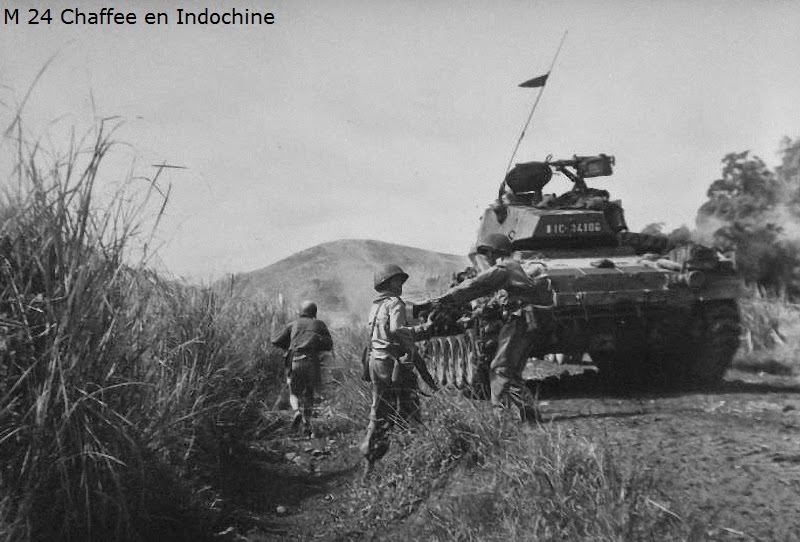
The M24 from Warlord is now build and detailed. No major problem with this easy kit, but the mount for the .30 machine-gun must be self-made as none is furnished contrary to the illustration on the box. I also made the mount for the aerial. I have also done some figures conversions to bring life to the subject.
Now to the LVT4 and then the painting.
Showing posts with label weapons. Show all posts
Tuesday, 3 June 2014
Sunday, 1 June 2014
Some armor reinforcement for the French - Part 1
Thanks to the fantastic wargaming resin kits from Warlord Games, we have easy access to some of the vehicles used by the French during this war. With a little detailing work and some nice painting they can bring variations to your French Indochina War games...
So I have started working on a M24 Chaffee light tank and a LVT4 amphibious tracked vehicle.
The versatile M24 was used in many situation in Indochina in support of infantry action.
Most notably, 10 of them were dismantled and transported to Dien Bien Phu were they were reassembled by a special team from the Legion. They were then used intensively by the « Escadron de Marche du 1er Régiment de Chasseurs à Cheval » in counter-attack to recover lost ground or opening road between fortified positions until the end of this epic struggle, firing some 15.000 rounds.
Each of the 10 vehicles bear the name of a famous French battle or French officer :
Conti from Captain Hervouet (Commanding officer)
1er Peloton
Mulhouse, Bazeilles, Douaumont
2e Peloton
Smolensk, Posen, Ettlingen
3e Peloton
Ratisbonne, Neumach, Auerstadt
Some of this tanks can still be seen at Dien Bien Phu today, sad relics of forgotten times
Thursday, 6 June 2013
The main individual weapons of the French paras. Part 5
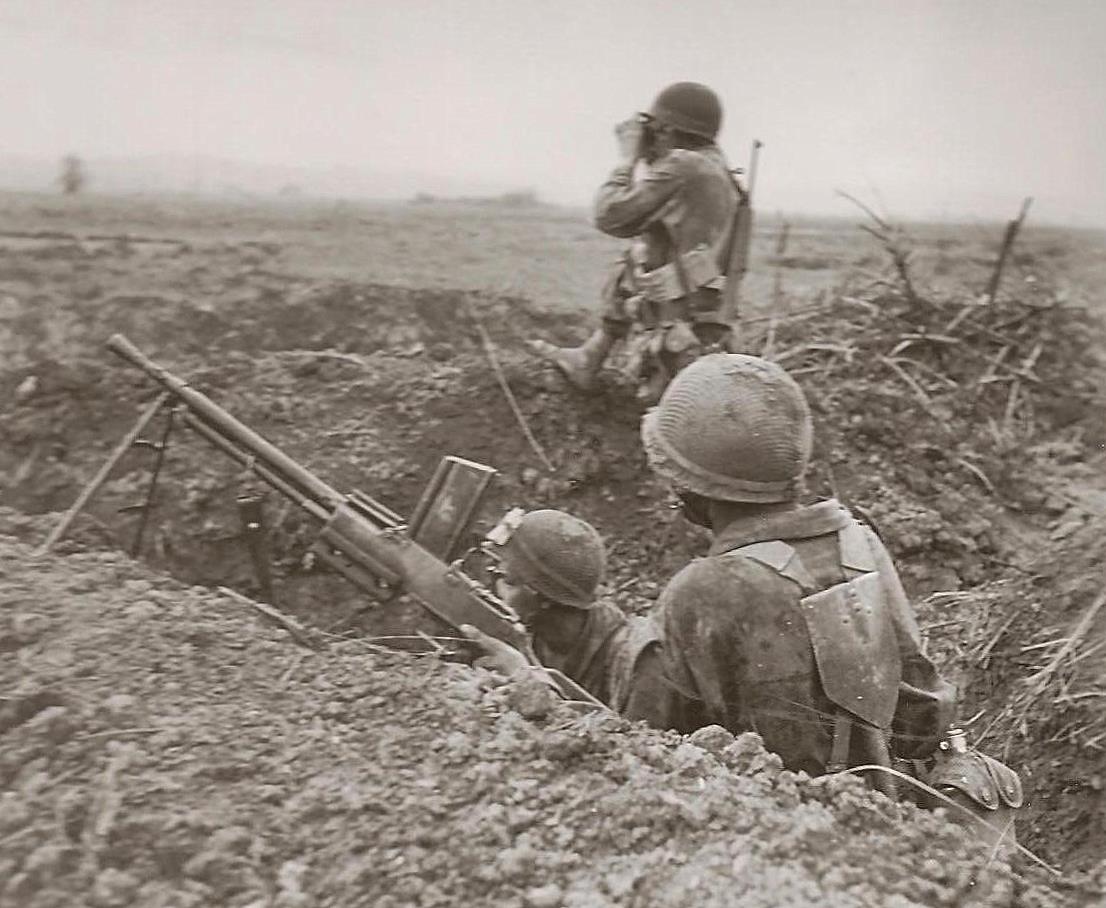
FM 24/29 Light machine gun
The FM Mle 1924 entered production in late July 1925 and saw first operational use in Morocco in May 1926. Due to the use of the LMG with the Mauser 8mm ammunition by the rebel during the Rif War, a new slightly shorter 7.5x54mm round was adopted in 1929. The modified fusil-mitrailleur modèle 1924 modifié 1929 (FM Mle 1924 M29) was mass-manufactured (187,412), beginning in 1930.
The fusil-mitrailleur modèle 1924 M29 was the standard light machine gun of the French Army from 1925 until the 1950s. His overall features were a folding bipod, an in-line stock, a pistol grip and a top-mounted 25-round detachable magazine. It has two separate triggers: the trigger in front for using semi-automatic fire only and the rear trigger for firing on full automatic. Protection of all the openings against mud and dust was excellent.
The cyclic rate was 450 rounds per minute. In general, it was a robust, accurate and reliable weapon, but the barrel was screwed well into the receiver, as in the Browning Automatic Rifle (BAR), and thus it could not be separated quickly and easily in the field as for the British Bren gun. To overcome this problem, the French instruction manual recommends the following routine for the FM 1924 M29: fire 4 to 5 detachable magazines (100 to 125 rounds) then take a short pause, then keep repeating that same restrained fire plus short pause routine which permits steady performance and very extensive firing periods.
The FM 24/29 was the workhorse in the First Indochina War and served in the French armed forces until after the end of the war in Algeria.
Friday, 24 May 2013
The main individual weapons of the French paras. Part 4
Grenades
There are 2 main types of French grenades, the Offensive Grenade model 1937 and the Defensive Grenade 1937. Both have an effective range of 30 m and external colors identifying their type of explosive. They are either all yellow or with the bottom part in red.
The Offensive Grenade model 1937 (OF37) is not a fragmentation grenade but use the blast to incapacitate the enemy in a 10 m radius of the point of impact.
The Defensive Grenade model 1937 (DF37) is a fragmentation grenade, lethal in a 5 m radius, and very dangerous up to 50 m.
The WW2 US Mk2 defensive grenade is also very common. It is a fragmentation grenade, color olive drab, and with a lethality similar to the French DF37.
Monday, 20 May 2013
The main individuals weapons of the French paras. Part 3
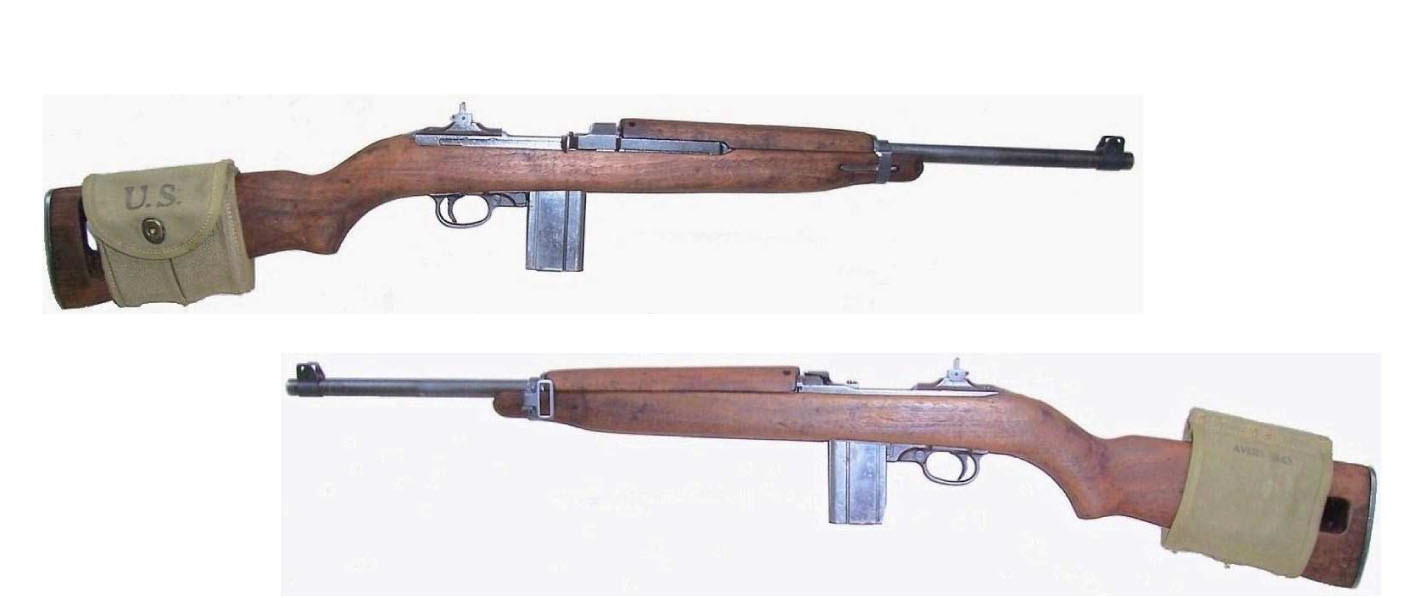
The M1 Carbine
The M1 carbine is a lightweight, easy to use semi-automatic carbine that became standard firearm for the U.S. military during WW2. With a total of 6.5 million M1 carbines of various models manufactured, it is the most produced American small arm of WW2.
The carbine was chambered for a new cartridge, the .30 Carbine, a smaller and lighter .30 (7.62mm) caliber round. The M1 carbine is accurate at short ranges, its effective combat range being around
180 m.
The M1 carbine, both in its standard and folding stock versions, was extensively used by the French paratroopers both in Indochina and Algeria albeit mainly by Officers and NCO.
Friday, 17 May 2013
The main individuals weapons of the French paras. Part 2
The Mat-49 smg
Developed by the French arms factory Manufacture Nationale d'Armes de Tulle (MAT) and first produced in 1949, the MAT-49 submachine gun saw widespread combat use during the First Indochina War and the Algerian War, notably with the paratroopers.
The MAT-49 had a retractable wire stock, which when extended gave the weapon a length of 720mm, and the magazine well and magazine could be folded forward parallel to the barrel for parachute jump.
It fires a 9mm cartridge, using a single-column 20-round or 32-round magazine.
Thursday, 16 May 2013
The main individuals weapons of the French paras. Part 1
MAS-36/CR39 Paratrooper Rifle
Developed in 1939 from the new French standard infantry rifle the MAS-36, the MAS-36/CR39 was a shortened, lightened and streamlined version of the latter. The new aluminium folding stock swings up against the rifle’s receiver with a recess allowing it to hug the rifles contours and possess an auto-winding leather strap that is wound inside the stock once the rifle is folded. With the stock folded the CR39 was just 62cm long while a full length MAS-36 was over 100cm long.
As the MAS-36 was already a very short weapon, by shortening it further the effect of recoil was increased. Additionally the single bolt hinge was susceptible to fatigue and, with time, can be very difficult to use.
Not used during WW2, the CR39 did however see extensive service during France’s post war colonial conflicts in both Indochina War and Algeria.
Subscribe to:
Posts (Atom)